Solar Upgrade!
We've been wanting to extend our stays Boondocking and at Harvest Hosts beyond a single night without having to run a generator every time we wanted to make coffee or microwave something or to top off the battery to stay another night.
After looking at all sorts of options from huge systems that would allow us to live off-grid to small subtle upgrades, we finally decided on a smaller system that should give us a few days off-grid without breaking the bank.
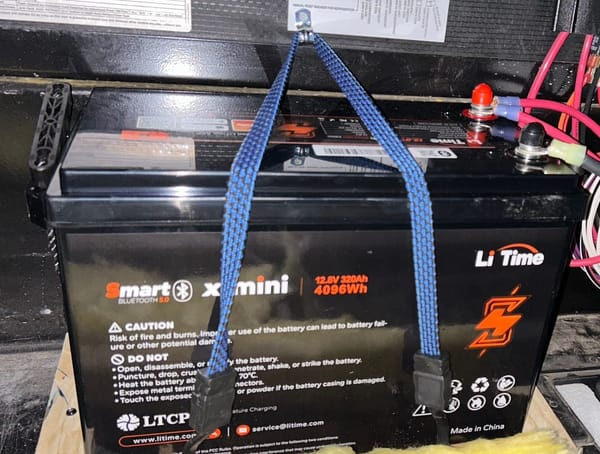
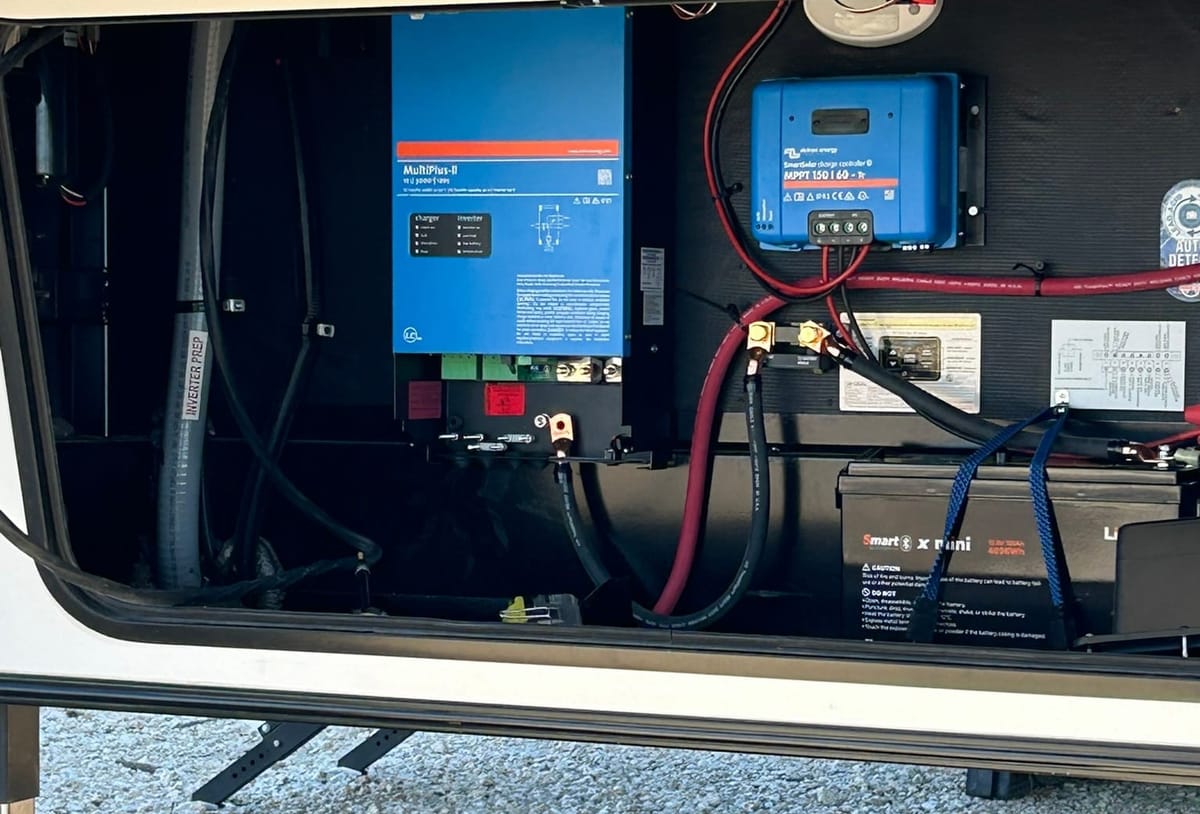
We had already purchased a 320Ah Lithium battery that gets us through the night easily with our 12V only, power hungry refrigerator and had bought a DC-to-DC kit so we could charge on the road even on cloudy days. In this latest install, we have added four 200W solar panels, a new Lithium capable Victron Solar Controller and a Victron MultiPlus-II Inverter/Charger that can provide up to 3000W of AC power so long as our battery can supply it.
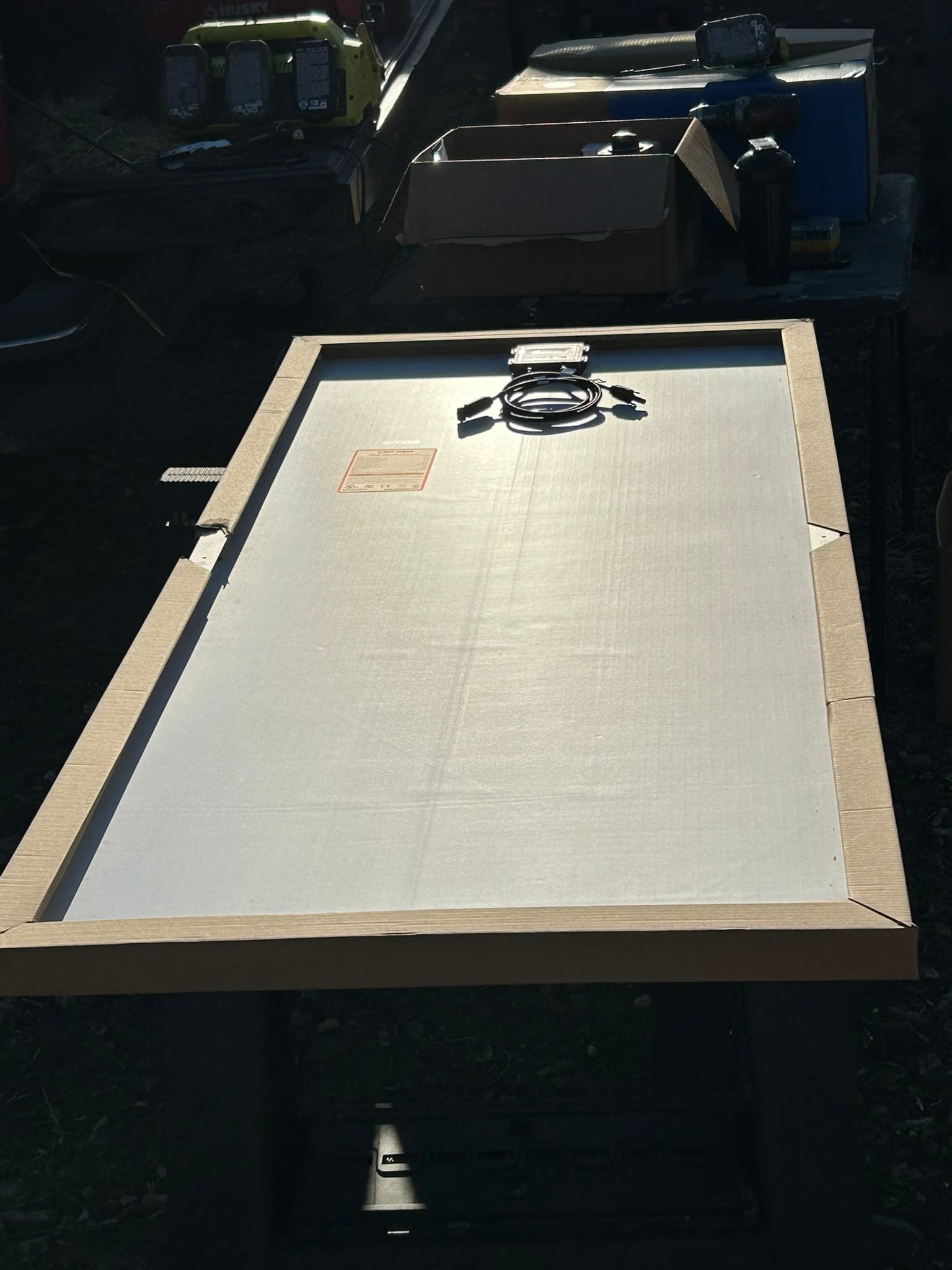
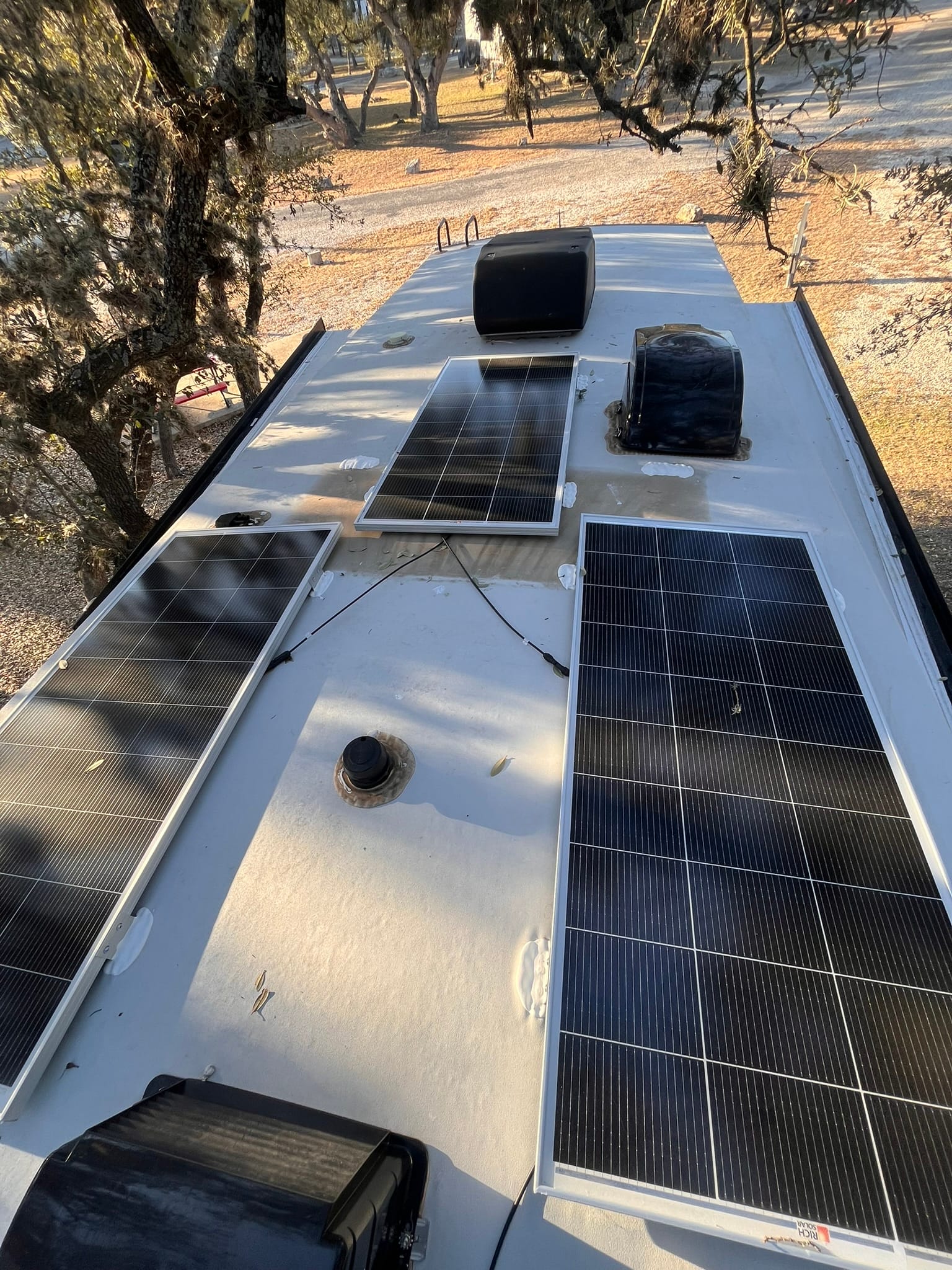
200W Solar Panel unboxing and panel layout
The inverter will pull power from the battery and invert the DC to AC so we can power various outlets and items around the RV for a limited time. The way it is installed takes the line from the shore cord away from the breaker box and sends all power to the inverter/charger and then DC to battery and AC back to entire breaker box. Some installs they only power one half of the breaker box but we chose to power it all. This allows us to run anything in the rig but might be very limited in how long we can do so! The A/C pulls 1500W after start up but will drain the battery in less than 2 hours. Kim's hair dryer pulls the same and has the same time restriction. During testing, we checked to see what various items in the rig would draw and we are comfortable that we have a decent solution so long as we keep an eye on the total Watts we are drawing!
You may be wondering how we decided on the design of the system and I would be remiss not to let you in on that. We have been talking together for some time and researching different solutions that people have posted online. Most of these are $20K plus designs that is just out of our budget, weight limits AND way too much for us we think. We laid out our needs based on our usual style of camping and not on some theoretical camping we might do once! We don't see ourselves camping in the heat of summer when we have to have A/C without being at a place where we can plug in. Our style of boondocking will be in the relatively cool part of the year and we would only probably stay 3-4 days. The other thing we decided was that I didn't want to have to get up in the cold mornings to run the generator every day just to make coffee or toast or microwave something. I don't even want to have to run the generator for several hours everyday to recharge the battery. Many places we camp have very restrictive hours when you can run a generator and you can't necessarily fill your battery back up from empty so we need some solar panels to help fill up the battery.
We talked with our installers, Tomaz Coast to Coast, who sent us to Jesse at Battle Born who helped us put a design together based on the needs listed above. Luckily, he said what we laid out was a very popular desire and he gave us a list of Victron products that would get us there. He also said four 200W solar panels on a decently sunny day would fill or nearly fill our 320AH battery which extends our ability to boondock significantly. We sent the list to Tomaz Coast to Coast who ordered them and had them delivered to their location. We set up a day to have it installed and they put the system together for us. I did my best to help by staying out of the way and asking lots of questions!
There are some tradeoffs with our size system. We probably can't run the A/C for very long at all especially without a soft start kit installed. An RV A/C can pull between 2500 and 3500W on start up and we have to be careful not to go over 3000W. We can power a lot of devices well below that as long as we watch the effects on our battery storage. This design is also expandable allowing us to add more panels or another battery if we want so we wouldn't have a lot of wasted money if we upgrade.
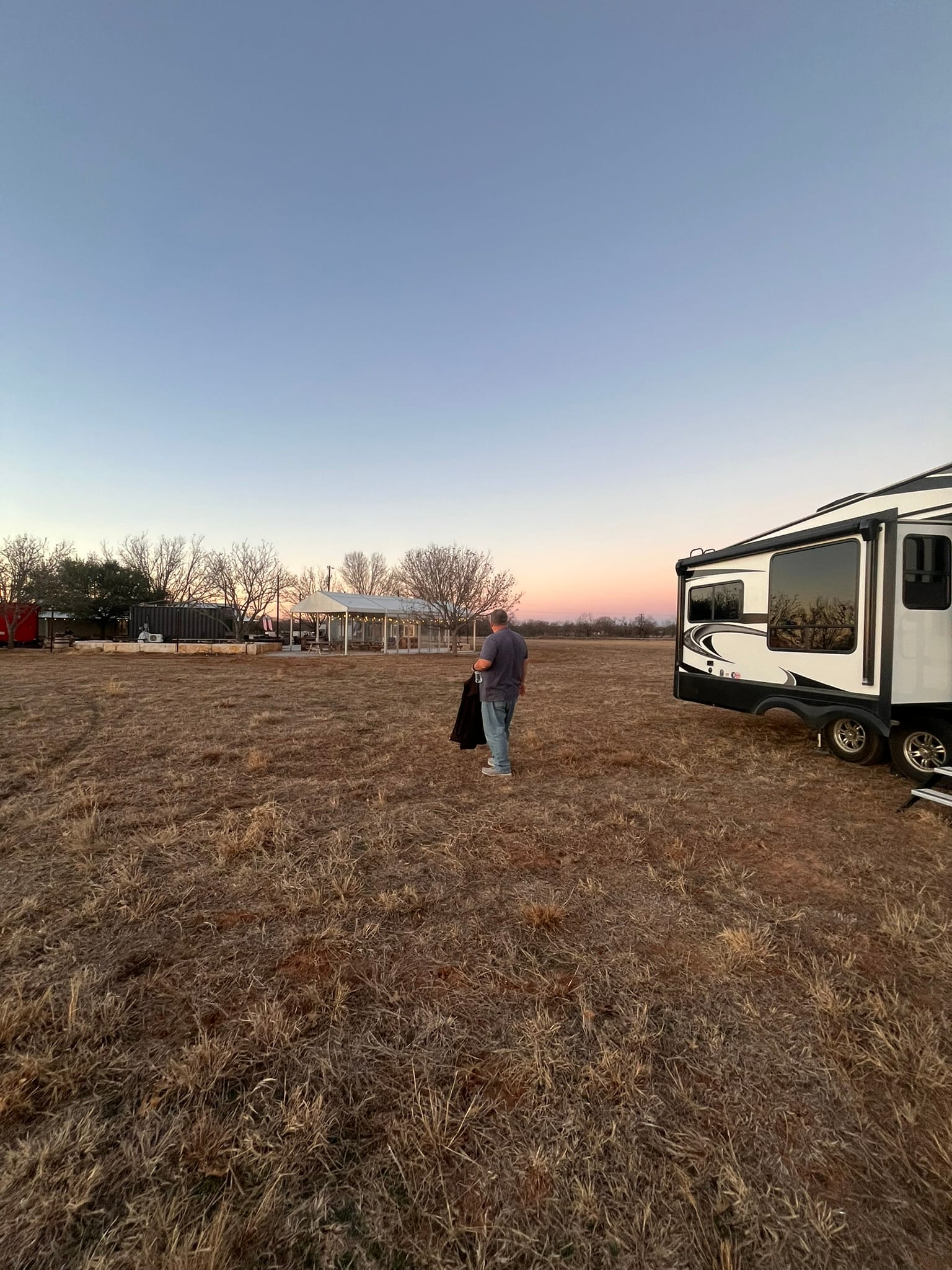

1693 Distillery Harvest Host (It would be improper not to try the whiskey!)
Results - The following weekend we spent 2 nights boondocking at a Harvest Host in Fredericksburg. We arrived with 98% full battery and overnight, with only 12V fridge and coach heater running, we dropped to 75%. In the morning, we were able to use a toaster and microwave with little change in the battery life but Kim's hair dryer pulled 1500W and our expected battery life (while using it) showed just under 2 hours but that popped back up to 34 hours or so when she shut it off. Her heated hair straightener was cycling on and off between 0 and about 500W of pull. (In other news, the results of the whiskey tasting was that the bourbon and honey whiskey were amazing and I got toasted!)
I should point out that these power numbers come from the LiTime app that came with the battery and the Victron app that interfaced with all the Victron hardware to give us control and status updates. Both are well designed apps and very handy to reference when running these tests.
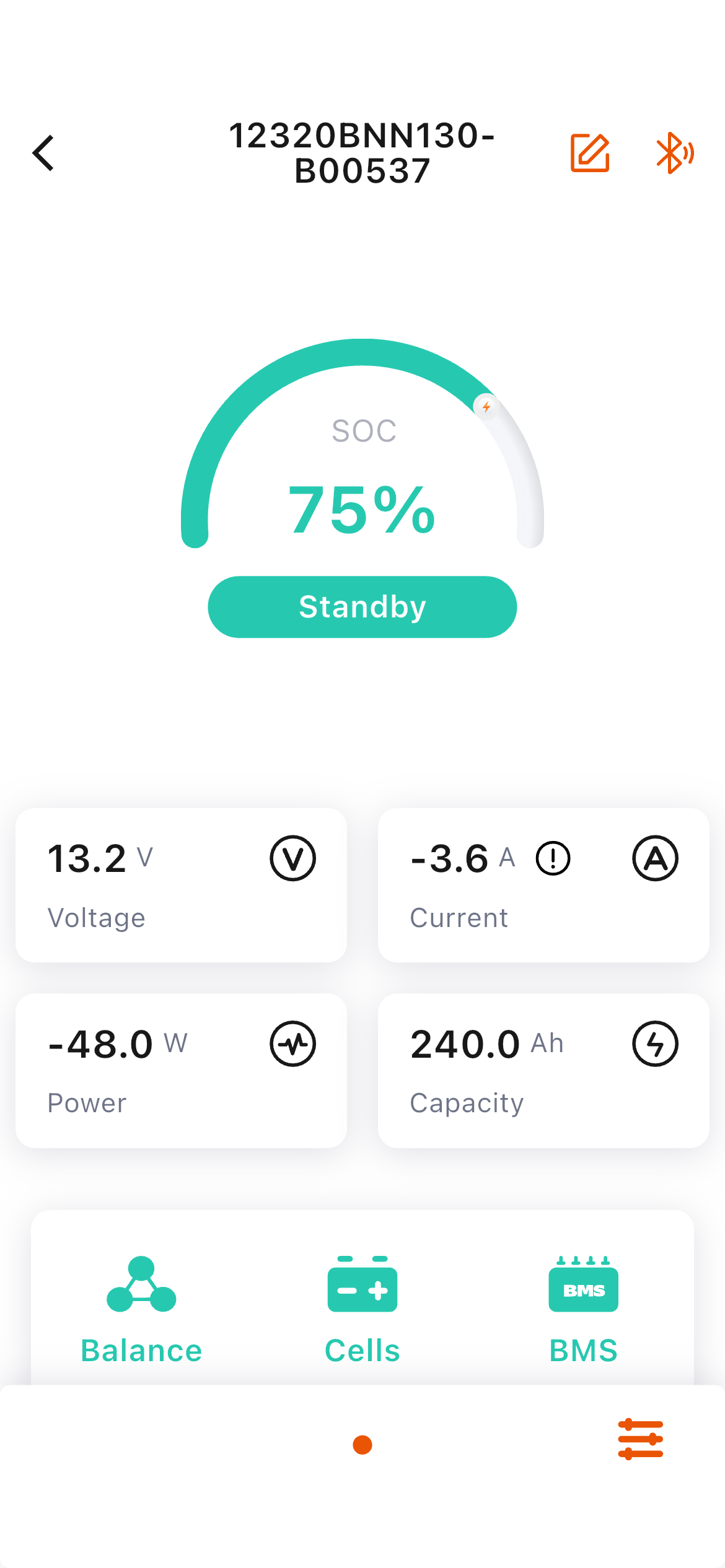
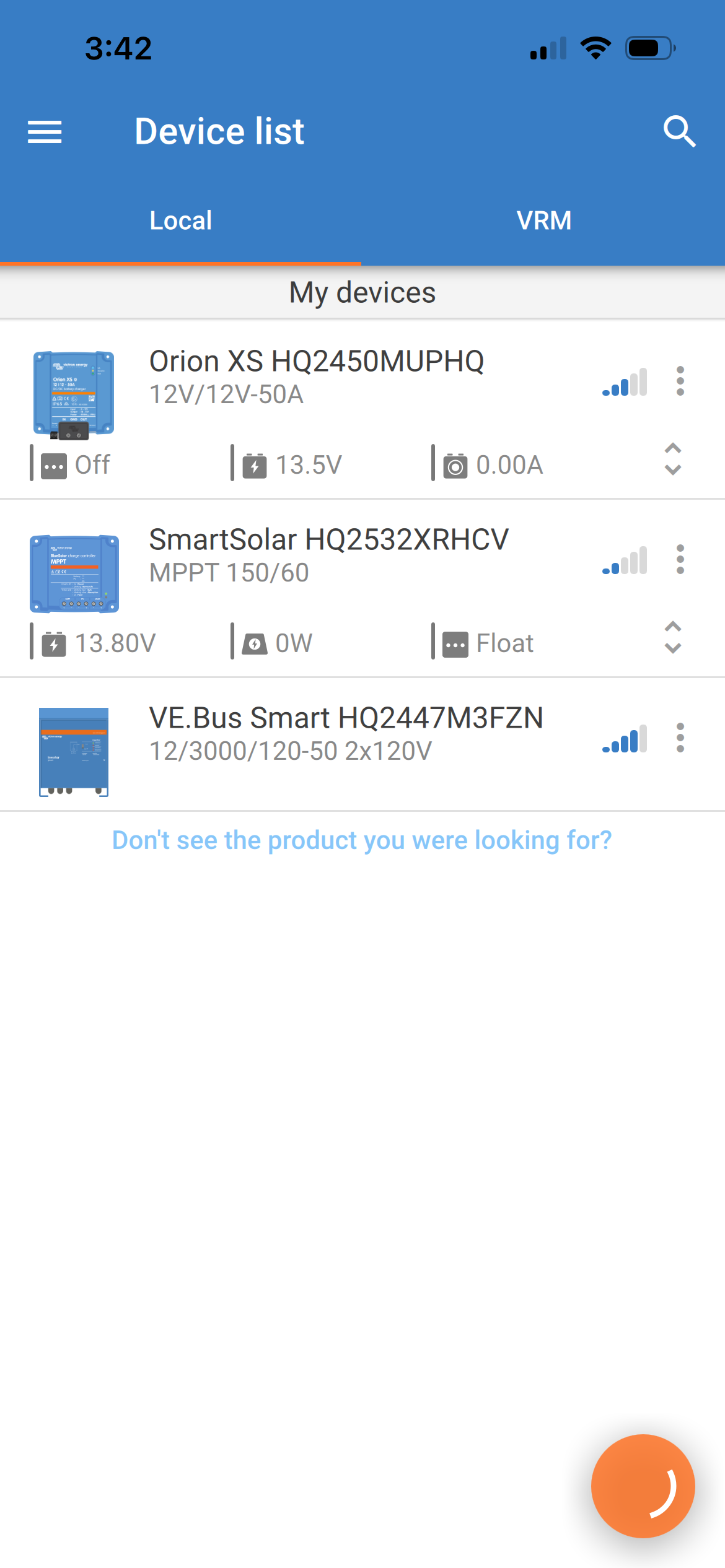
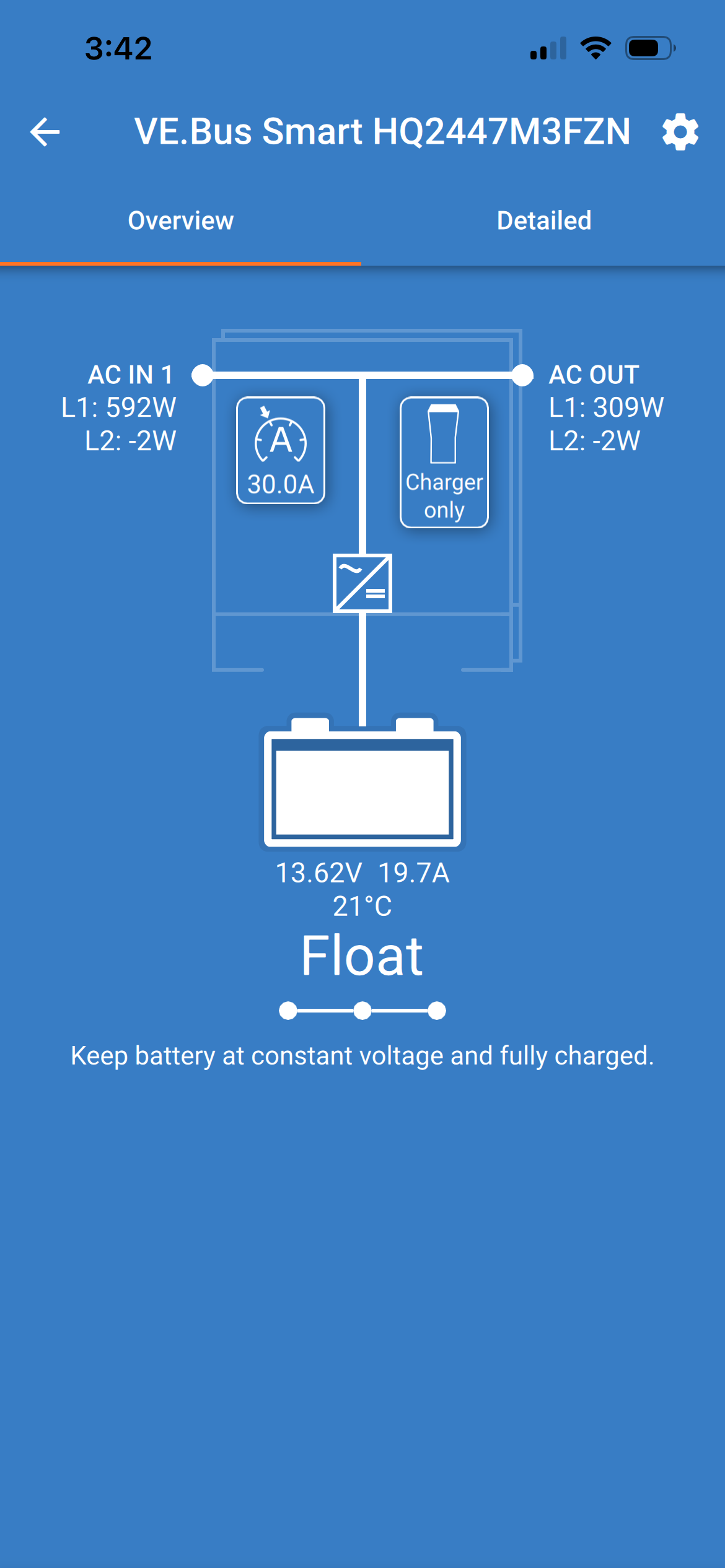
LiTime App (left), Victron App (center and right)
That day was sunny but we had parked poorly for the geometry of our rig's panels and still got back into the mid 90's on our battery. Solar was pushing 240W to battery and 2KWH total generation for the day. Overnight that night, the battery went down to 55% and was 51% by the time we left. The solar added 10% back in the hour and a half we drove back to our home campground. Once we plugged into shore power, the inverter/charger was pushing 1500W to the battery to get it charged back up quickly and did so in just over an hour. Our old power converter was limited to 50W max and could take a long time to charge the larger battery we have now. Overall the test was pretty good considering it is winter so the Sun is lower on the horizon and I made the unforced error of parking in the exact wrong direction that tipped the panels away from the Sun. Though I have to admit, most campgrounds won't allow you to pick any old angle to park so maybe it was a good test at the worst time of the year and worst angle. Time will tell!
For the geeks out there here's some more technical discussions:
Lithium batteries take a different charging profile than the old lead-acid type batteries. The lithium profile has three sections: bulk, absorption and float. Bulk or constant current provides a constant current until the desired voltage is reached and then switches to absorption which provides a constant voltage until the current drops to near zero. For many lithium batteries this is where it stops but some systems have a "trickle charge" called float to keep them topped off without reducing the life span of the battery. See the following website for a deeper discussion and some cool graphics: Battle Born Batteries
The inverter/charger is an interesting piece of equipment. It takes the shore power and pushes up to 1500W to the battery if it needs charging. When shore power is interrupted either deliberately or via a power outage, it instantly changes to drawing power from the battery and produces 120V AC for as long as the battery will last. For us, this could be an issue since we don't have a ton of battery storage and we have a limit of 3000W. If our A/C is running when the power is cut, the inverter will try to run it because of the way our installation is done. We risk overloading the inverter.
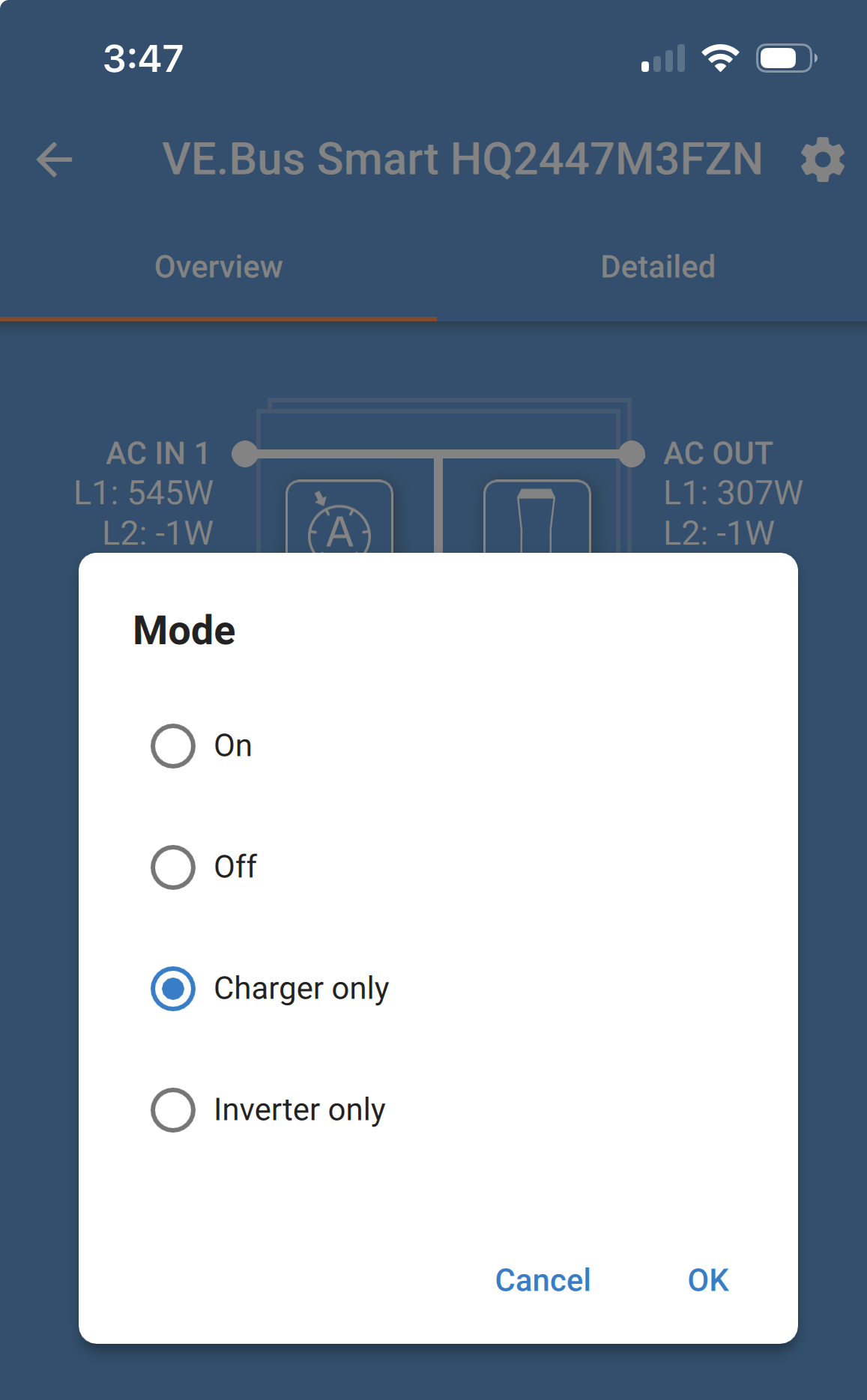
The inverter/charger has four operational modes: off, on, charger only, inverter only. "Off" is mostly self explanatory as is "On". "Off" allows shore power to pass through unrestricted and "On" allows both inverting and charging functions. The other two have their uses as well, since we don't necessarily want 120V AC power while driving down the road so we could turn off the inverter portion or even just turn it off completely. I had worried about the power pull in the RV if we left it on but looking at the app, it was suppling about 15W to something (microwave clock??) but the solar panels were supplying 140W even on a cloudy day so I may not have to worry about that since the battery was showing it was charging.
Additionally, while parked on shore power we might want to have it on "charger only" so that if the power goes out, we don't kill our battery on AC power and save it for the 12V refrigerator but it keeps the battery topped off. I'm still thinking through the options and what they mean but this is the option I'm using at the moment at our home campground.
Let me know if you have any questions or suggestions on how best to use our new system!