Some Thoughts on Full-Timing - Style of Camping
This is the fourth installment in the series "Thoughts on Full-Timing". If you have missed any of the previous you can catch up here: https://www.braysaway.com/
In today's article we discuss different styles of camping. For instance, some people always camp at a campground with full hookups. I think of this as the default option. There are a lot of pros: generally you will have an improved site with gravel, concrete, pavement or at least hard packed soil to park your RV. The roads in and out are generally wide enough and tall enough to get rigs in since they are high traffic areas. Another positive is you don't have to worry about power storage or generation. I've seen older campgrounds with as low as 15A connections but generally they will have 30A or 50A service these days. The downside is these are the most expensive way to camp. The days of regularly finding $30 dollar a night spots are gone. I've found a few sites with electric or electric and water for $30 but not full hookups.
The next style of camping is partial hookups. These can be found in many places like state parks, national parks, Harvest Host, even some Corps of Engineers (COE) and Bureau of Land Management (BLM) sites can have some hookups. The most common seems to be power with no water or sewer on the site. They may have potable water available to fill your tanks and a dump station to clean out before hitting the road. We've stayed in plenty of these types of campgrounds and they are generally cheaper. The downside is of course you have to live off your tanks both for fresh water and showers if they don't have shower houses or bathrooms and sometimes if they don't have potable water or a dumpstation, you have to show up with a tank of water and find somewhere else to dump. This requires you to drive down roads with a lot of extra weight in your tanks and that can cause issues. I've seen rigs where the fresh tank or one of the gray or black tanks have fallen out! Again, you don't have to worry about power storage or generation.
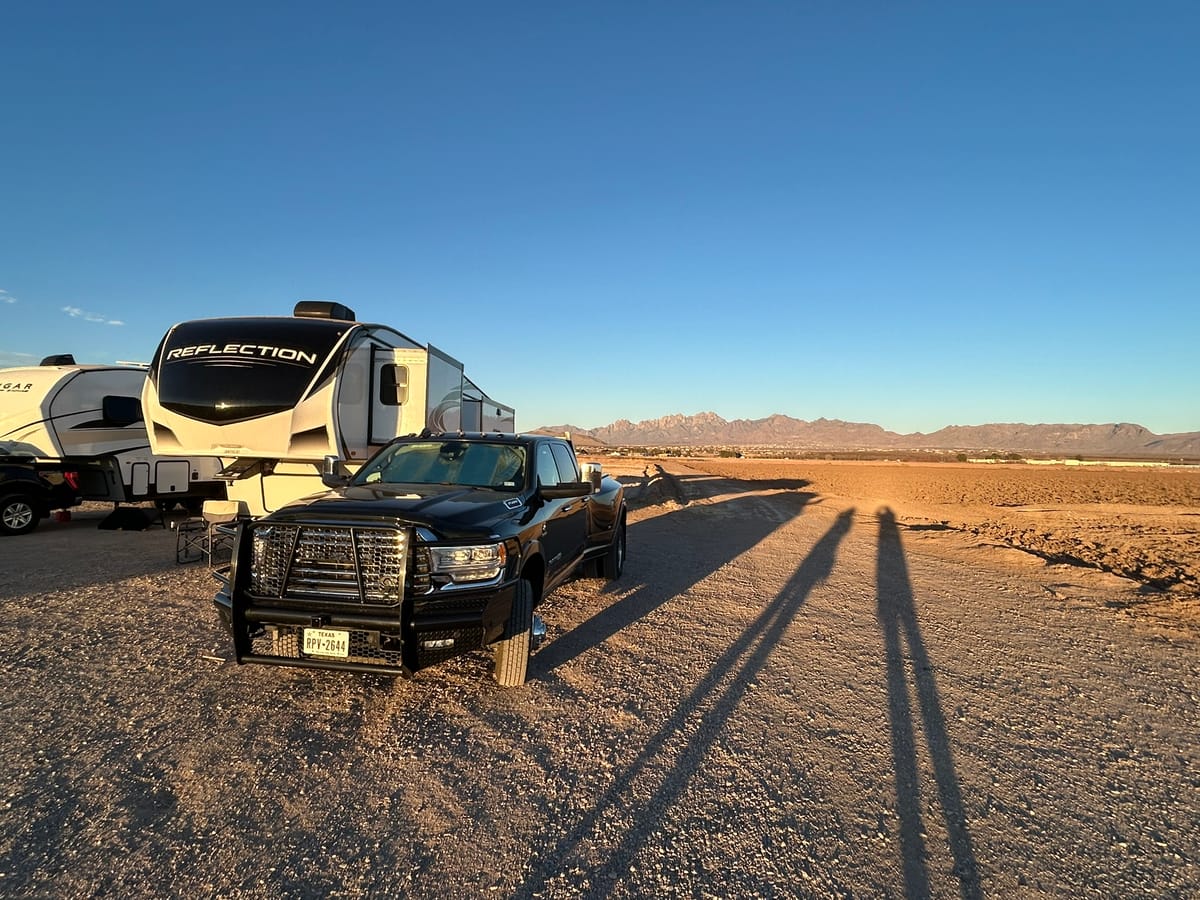
The last general style of camping you may want to indulge in is true Boondocking off the grid! No utilities of any kind. We've run into this situation in some state parks and national parks with no hookups, at some Harvest Host sites and we have heard the majority of COE and BLM lands are this way. This is also true for almost all businesses that allow you stay in their parking lots. The plus for this style of camping is that it's generally the cheapest with costs ranging from free or just a park pass or similar to small token fees of $20 or so to camp there. Clearly you have the same issues with bringing in your own fresh water and carrying out your gray and black tanks to dump elsewhere if they don't have a dump or potable water available.
The biggest issue with this style is you have to come self contained with electric storage and generation. The small lead-acid battery these rigs generally come with are good for maybe one night if that and then need recharging. The modern Lithium batteries are much better and run from 100AH to well over 300AH which might be able to power you for days before needing recharge depending on what you have pulling 12V in your rig. For us our limiting factor is our 12V refrigerator that pulls a lot of watts while running and used to deplete our lead-acid battery before the night was over! If you are only running some LED lights your battery may last a very long time.
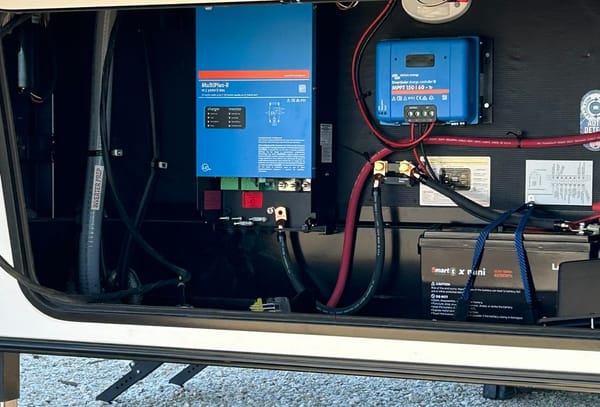
Depending on how long you want to stay out in the boonies off grid, you may also need to have a way of generating more electricity and charging your batteries. You also have to consider whether you want to power AC equipment or just your DC equipment. There are several ways available to recharge your batteries including a generator, solar panels, DC-to- DC converter and shore power to name the most popular ones.
A generator, either internal or external, is one of the easiest options. Many kinds of RVs come with them pre-installed or at least "plumbed" for them. Ours didn't so we purchased an external generator capable of providing 30A service so we can run up to 1 A/C and almost all our electronics in the RV ... but not all at once! You still have to do some Watt counting to be sure you don't pull too much power and trip a circuit breaker either in your rig or on your generator. We did that once using a microwave and heater and the A/C kicked on. Just as in most rigs, you need to keep the heating elements down. Use only a toaster, toaster oven, electric heater, hair dryer, coffee maker, etc one at a time. Those will trip a breaker even on shore power with 50A service because a lot of rigs have nearly all outlets on one circuit.
While a generator is a sort of "get out of jail free" card, there are some considerations when planning to use that option. Many campgrounds allow them but restrict their hours of operation to 2 hours in the morning and 2 hours in the evening. I have found that 4 hours a day isn't always enough to completely restore my battery to get through the next night especially when they only give you 2 hours before having to go all night and the morning charge might only have been enough to get you through the day if you don't have solar.
The second method is solar panels. I'll save a lot of the discussion on solar for a separate article. Our rig came with one 165W solar panel that really was only good for a trickle charge keeping the battery charged. Don't get me wrong, it helped recharge the old lead-acid and our first small lithium battery going down the road but was going to take forever to completely recharge it back to the point where they would handle the load over night again! We are looking to add about 1000W of solar panels and that should help stretch our battery life out a few extra days.
The third method I'm going to cover is DC-to-DC converter which pulls power from your truck alternator and charges the batteries in your RV. If you have Lithium batteries in your RV and you want to charge this way, you need a DC-to-DC converter that controls this charging. Lithium batteries have a much lower resistance and will pull everything your truck alternator can generate and ultimately damage the alternator! There are many manufacturers who make the DC-to-DC converter that prevents this and provides the slightly higher voltage that lithium batteries need to fully charge. If you are considering this upgrade be sure to do your homework online. There's a lot of discussion forums and videos showing how to safely do this. This method allows you to recharge your batteries from your running truck either while going down the road or, in a pinch, sitting in the campground (say on a very cloudy day or rainy day when solar isn't helping much!)
The final method is of course, just plugging into shore power which may seem redundant but if you are just staying out off the grid for a couple of days, you may have enough stored power to get you through until you reach another campground with electric hookups or home to your own electric grid. Either way, you can then let your power converter do the job at your leisure. We often resorted to this method as we travel by limiting the number of consecutive nights spent boondocking.
Lastly, a quick discussion of inverters for 120V applications. Living off your batteries is wonderful right up until you want to run a 120V device like a toaster, microwave or A/C unit and then you have a problem. You need an inverter to create 120V AC power from your 12V DC battery(ies). If you have enough battery storage you can get inverters that produce a wide range of watts. I've seen adds for 1000, 2000, 3000 Watts and beyond just depending on what you want to run. You'll still have to do some "Watt management" and not run everything at once but with the right equipment and battery storage you might be able to run just about anything you have. My wife and I aren't too worried about running A/C's and such but short term toaster, hair dryer, coffee maker, computer and Starlink or equivalent internet access, is definitely a plus. We are considering a simple solution of a minimal Watt inverter that shares our existing 320AH battery with all the other 12V devices. We'll have to manage it carefully, but it's simple and affordable solution. I'll include a discussion of bigger solutions in the solar article coming next.
As you can see the style of camping you want to do will affect your budget needs, camper type and your electrical storage and generation ability. They are all absolutely interrelated!